Applications
Six ways customers install our shade cloth
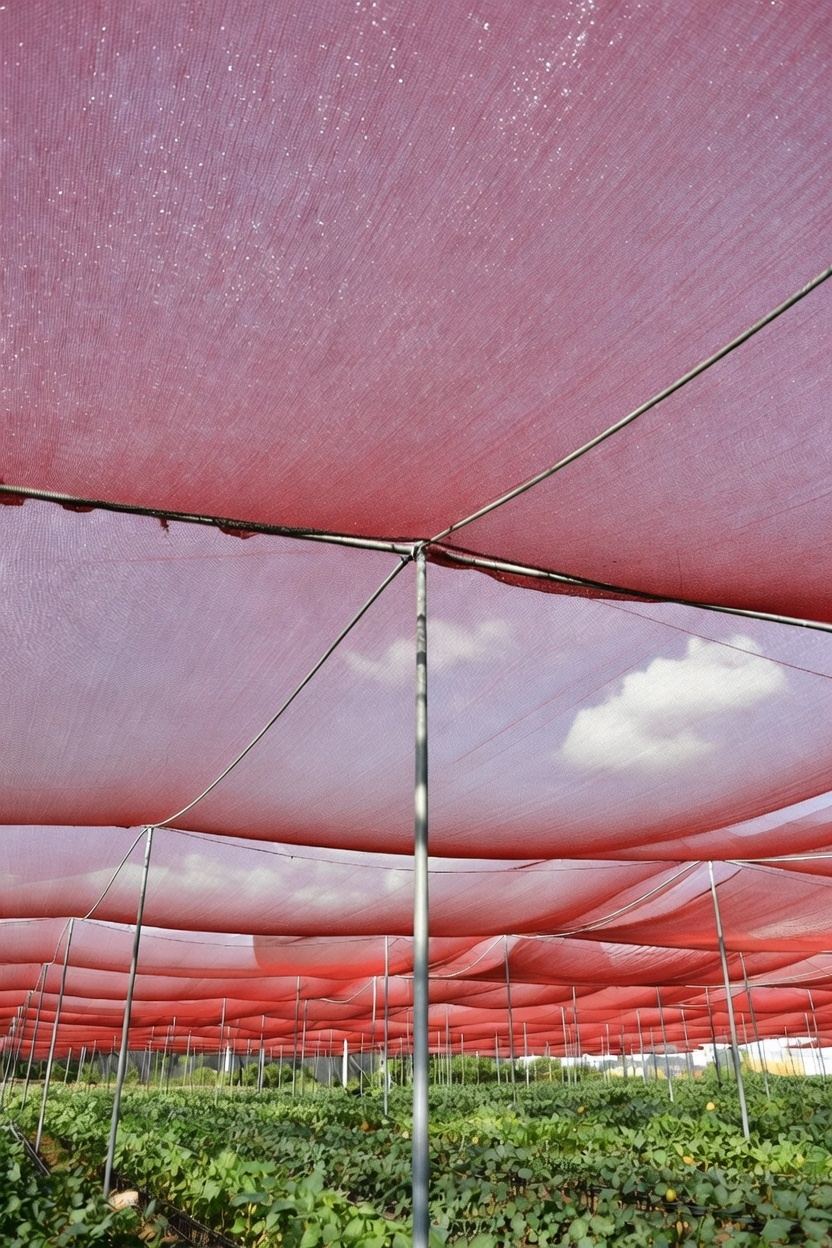
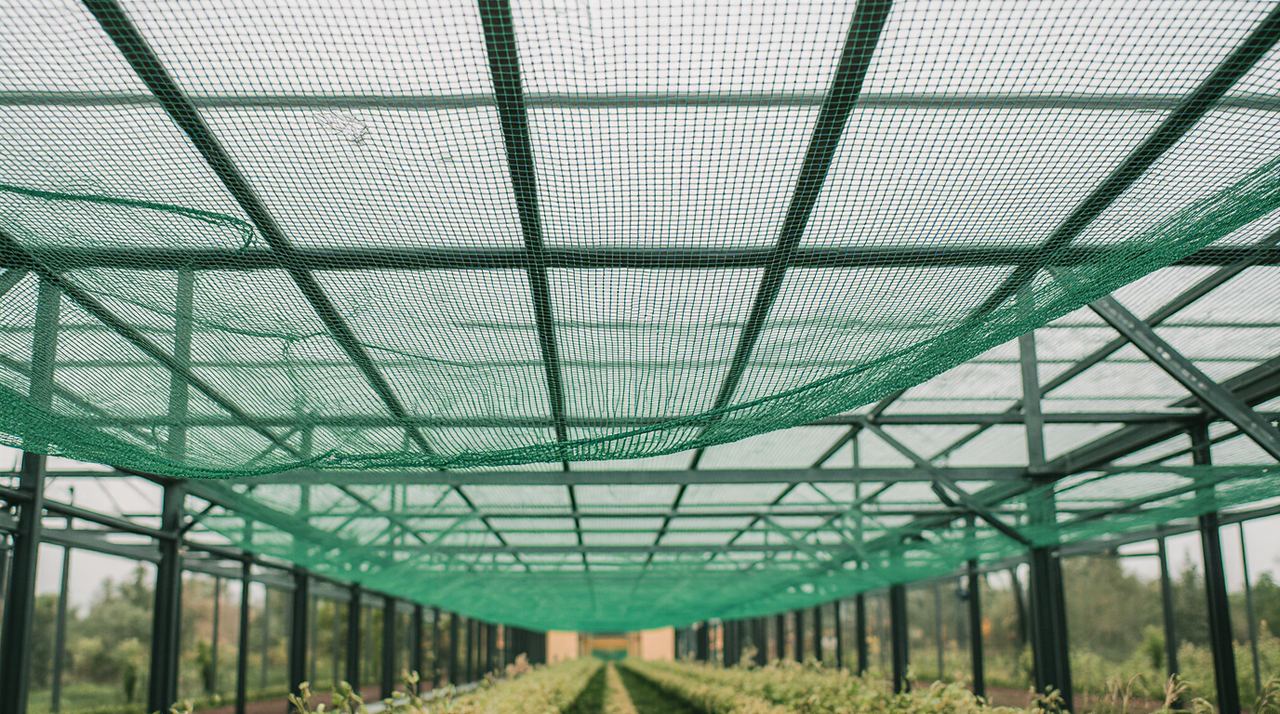 Greenhouse tunnels
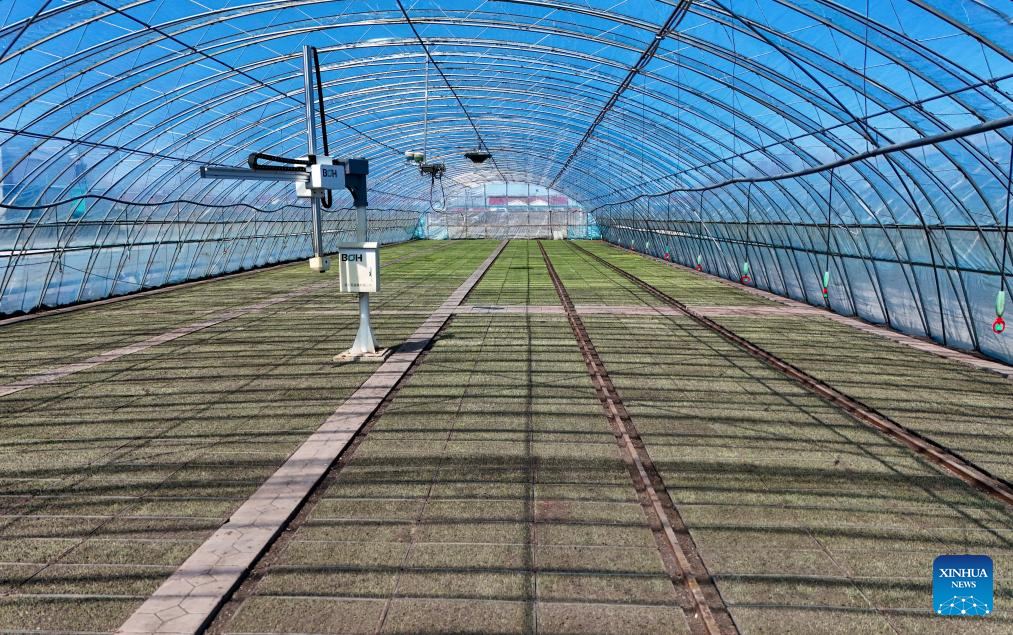 Interior screens
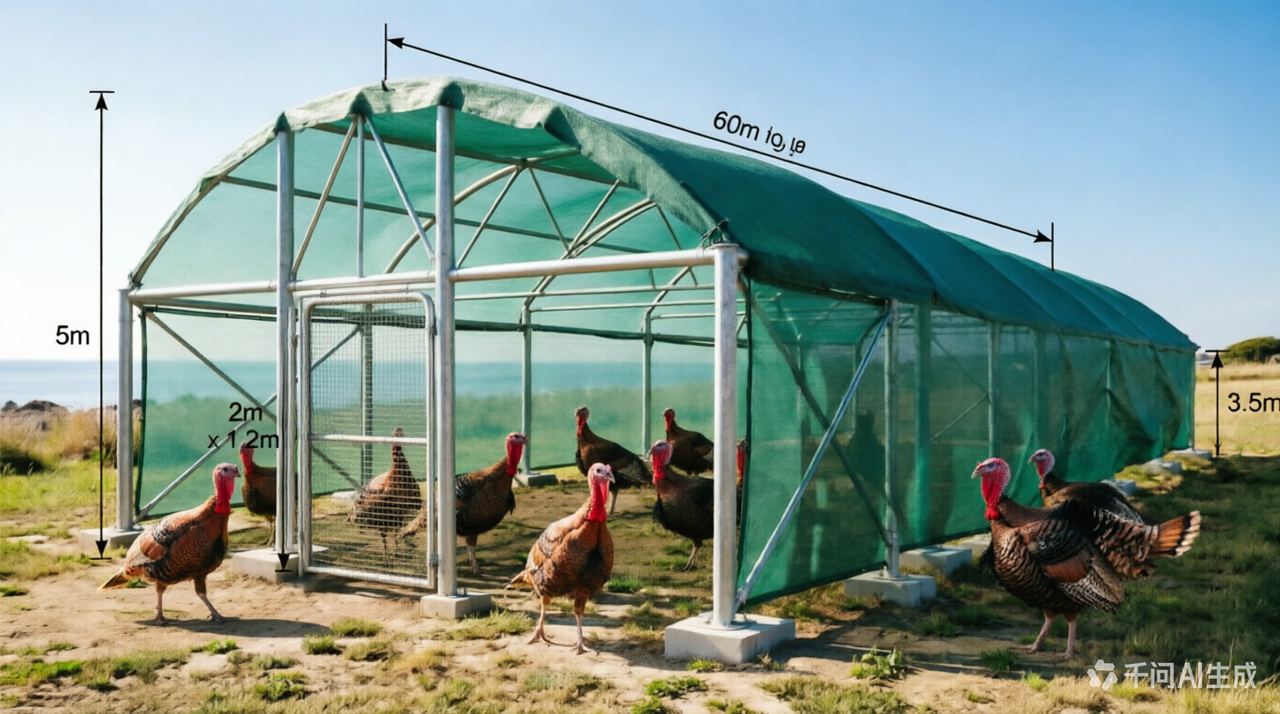 Poultry shelters
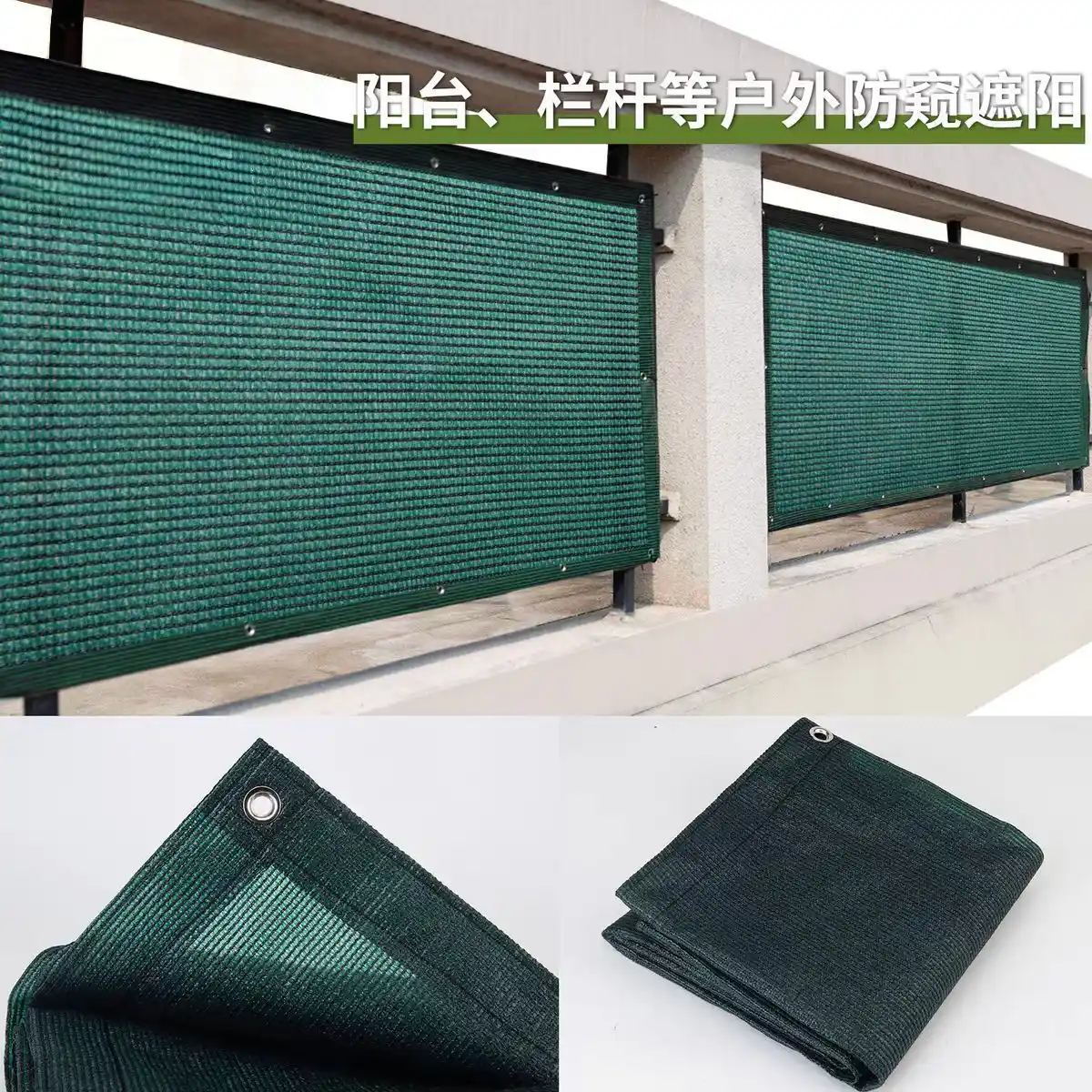 Balcony privacy
 Shade sails
 Light control
Ciflower HDPE Shade Netting — Shade Cloth & Sails
One mill for shade cloth rolls, finished shade sails and stainless hardware: 55–300 g/m², 30–95% shade, 1–12.99 m wide in one piece, colour matched, eyeleted and packed for container export.
HDPE shade netting
Shade netting is the volume product at our mill. We weave it from HDPE monofilament and tape yarn on Raschel machines, heat-set it so the mesh stays square, and finish it to whatever edge your frame needs — raw, hemmed, eyeleted or rope-bordered.
Because the shade factor is created at the loom rather than by a coating, the cloth breathes. Air moves through the mesh, heat does not build up under it the way it does under solid film, and rain passes instead of pooling. That is why shade net is used for greenhouses, orchards, poultry houses, car parks and balconies rather than plastic sheeting.
The range covers 55 g/m² 30% shade at the light end, 65–80 g/m² 40% for patios and bedding plants, 80 g/m² 50% for light diffusing, 150 g/m² 75% for general crop protection, and 200–300 g/m² 90–95% for shade-loving plants, livestock cooling and privacy. Black, green, grey, white, sand, charcoal, blue, red and orange are standard, plus aluminised silver constructions for high-radiation sites; other colours are matched to a Pantone reference on request.
| Specification | Details |
|---|---|
| Material | 100% virgin HDPE, flat or round filament |
| Weight | 55 / 65 / 80 / 150 / 180 / 200 / 250 / 300 g/m² |
| Shade factor | 30% / 40% / 50% / 70% / 75% / 80% / 90% / 95% |
| Mesh | Flat: 6×6 to 12×12 per inch · Round: 40–80 mesh |
| Width | 1 m – 12.99 m in one piece, seamless |
| Roll length | 50 m / 100 m, or 5 m retail rolls (1.83 m wide) |
| Colours | Black, green, grey, white, sand, charcoal, blue, red, orange |
| UV package | HALS + UV stabiliser, 3–10 year service life |
| Edge options | Raw, hemmed, eyelets @50 cm, rope border, sewn lap joins |
| Packing | Poly bag + roll label, woven sack or carton, palletised |
| MOQ | 500 m² per colour (stock) · 3,000 m² (custom) |
| Reference price | From USD 0.11/m² FOB China |
Selection guide
| Shade | Typical weight | Best for | Notes |
|---|---|---|---|
| 30% | 55–65 g/m² | Full-sun vegetables (tomatoes, peppers), mixed greenhouses in mild climates | 70% of light still reaches the crop — maximum airflow, minimum stretch |
| 40% | 65–80 g/m² | Patios, pergolas, bedding plants, lilies, most vegetables | 60% light transmission — the usual residential and mixed-crop choice |
| 50% | 80–100 g/m² | Lettuce, herbs, young seedlings, car parks | Light diffusion without stretching plants; cheapest per m² |
| 70–75% | 130–160 g/m² | Tomatoes, peppers, cut flowers, general nursery | The most common agricultural specification worldwide |
| 80% | 180–200 g/m² | Orchards, berry tunnels, shade-loving ornamentals | Good balance of cooling and airflow |
| 90% | 200–250 g/m² | Poultry houses, livestock, fern and orchid shade | Noticeably cooler under the net; blocks more wind |
| 95% | 250–300 g/m² | Privacy screens, construction dust screens, dark houses | Near-opaque; use where airflow still matters |
| Aluminium-reflective | 150–200 g/m² | Gulf, Australia, high-radiation sites | Reflects radiation instead of absorbing it |
If you are unsure, tell us the crop, the latitude and the frame height. We will recommend a percentage and a colour — white and aluminium run cooler than black at the same shade factor.
Light end of the range
Most buyers ask for 70% or 80% because that is what the last supplier sold them. In a mild summer climate that is often too much: the crop stretches toward the light, the canopy stays wet longer, and you pay for cloth you did not need.
30% shade cloth lets about 70% of incident light through. It is the grade for full-sun vegetables — tomatoes, peppers, cucumbers — and for mixed greenhouses in mild climates where the goal is knocking the edge off midday sun without slowing growth. At 55–65 g/m² it is the lightest cloth we weave, so it also loads the frame least.
40% shade cloth transmits about 60%. It is the usual choice for patios and pergolas, bedding plants, lilies and most vegetables — enough relief that people and seedlings stop scorching, still open enough that air moves and plants do not etiolate.
Rule of thumb from our side of the desk: match the percentage to the sun, not to the catalogue. Mild, cloudy summers sit at 30–40%; hot continental summers at 50–60%; desert, Gulf and tropical sites start at 70% and often need white or aluminised cloth to avoid heat build-up underneath.
| Specification | Details |
|---|---|
| 30% shade | 70% light transmission · 55–65 g/m² · black |
| 40% shade | 60% light transmission · 65–80 g/m² · black |
| Also standard | 50% · 70% · 75% · 80% · 90% · 95% |
| Construction | Lock-stitch Raschel warp knit — cut it with scissors, it will not unravel |
| Cutting | Raw edge is fine; hemming optional, not required |
| Edge options | Taped hem with eyelets @50 cm, rope border, or raw cut |
| Roll widths | 1 m – 12.99 m in one piece, up to 50 m rolls |
| UV package | HALS + UV stabiliser, 3–10 year service life |
| MOQ | 500 m² per colour (stock) · 3,000 m² (custom) |
Why the cut edge matters. Woven shade cloth frays the moment you cut it, so every panel needs hemming before it goes on a frame. Our lock-stitch knit holds its edge, which means a 30% or 40% panel can be sized to the exact opening on site with scissors — no sewing machine, no waiting for a finished size.
Applications
Greenhouse tunnelsInterior screensPoultry sheltersBalcony privacyShade sailsLight controlWeave and colour
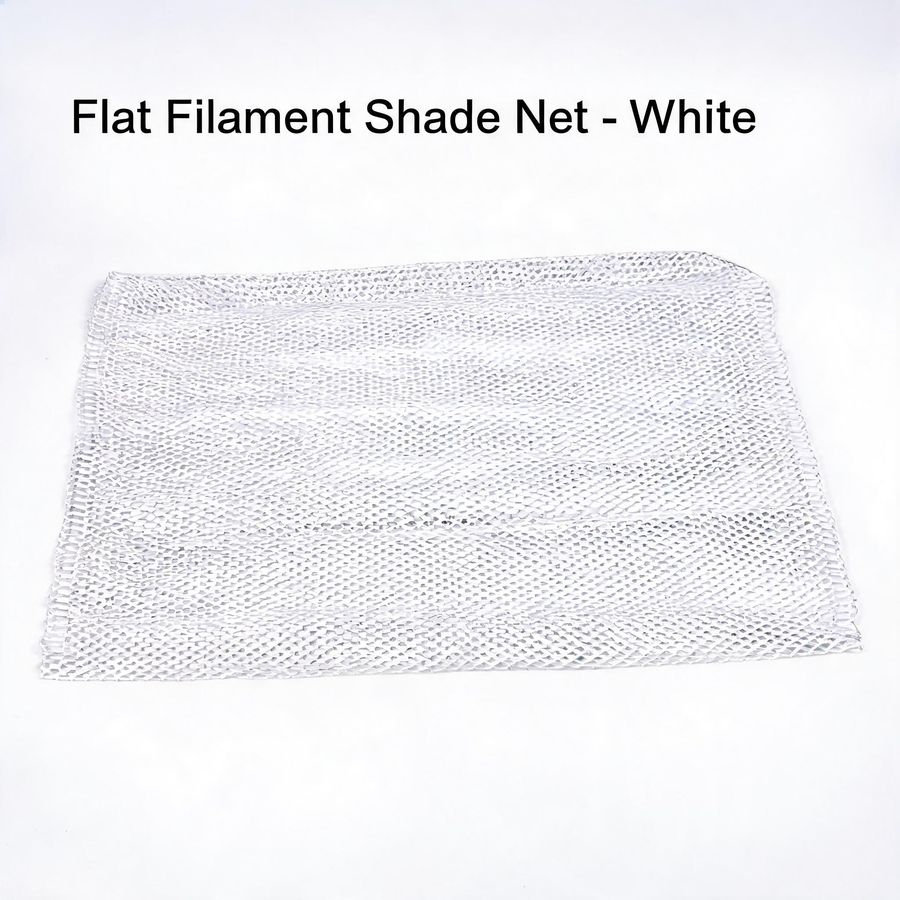
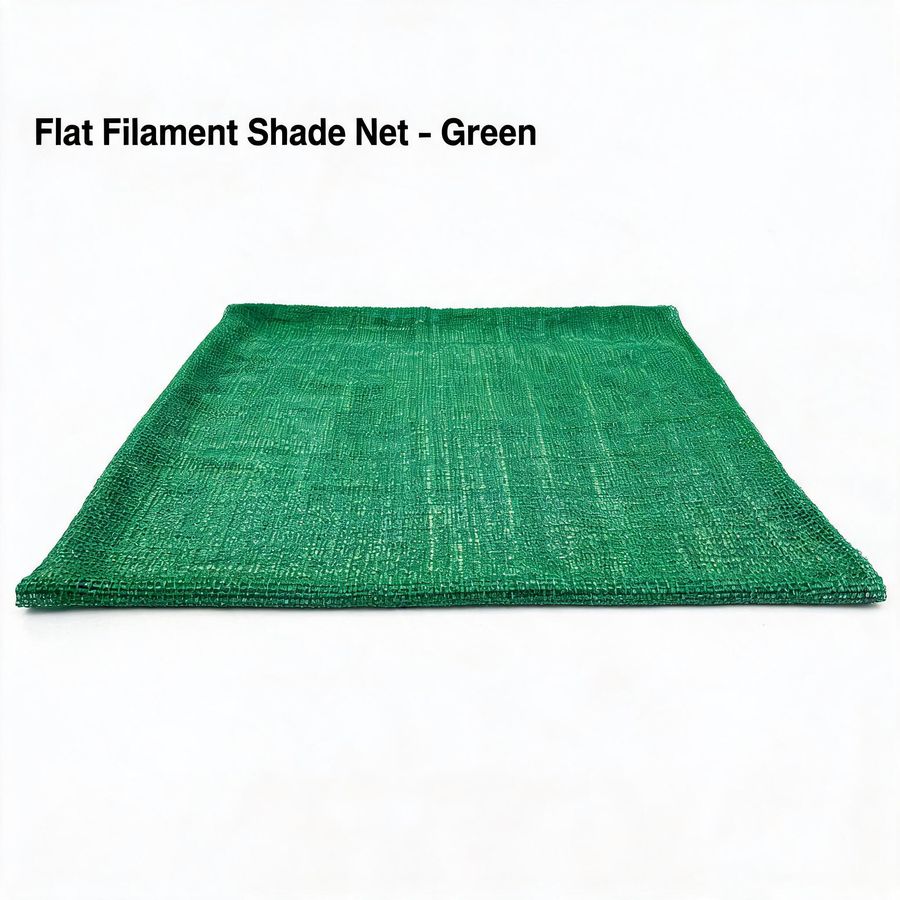
The same shade percentage can be knitted two ways, and the difference shows up on the frame rather than on the spec sheet. Flat filament uses tape yarn: lighter per square metre, a more uniform shadow, and the cheaper option for large covered areas. Round filament uses monofilament: a stiffer, more open fabric that sheds wind and holds its shape across a wide span. Colour matters too — a black net of the same shade factor runs hotter underneath than a white or aluminised one, because black absorbs rather than reflects.
 Flat filament · white
 Flat filament · green
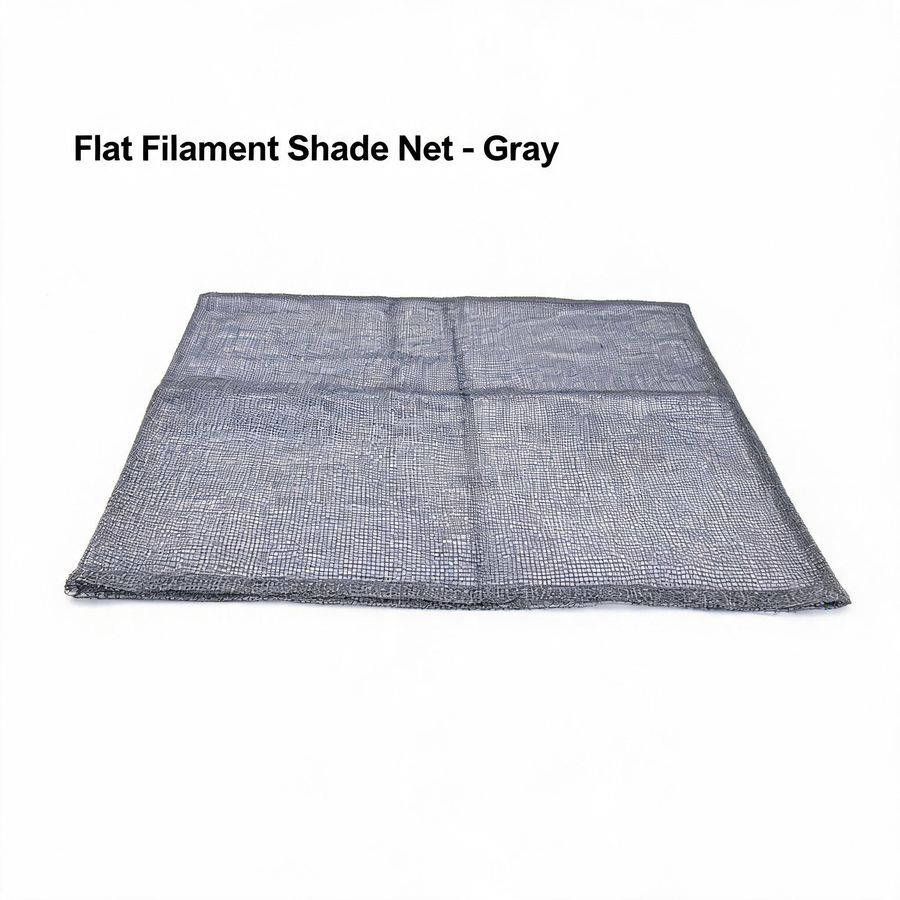 Flat filament · grey
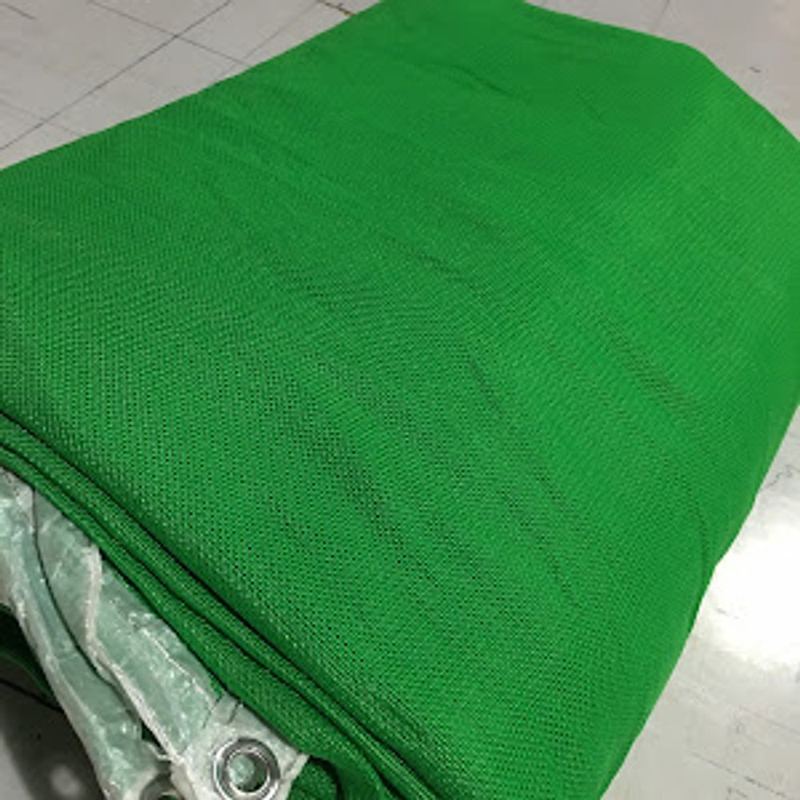 Roll stock · green
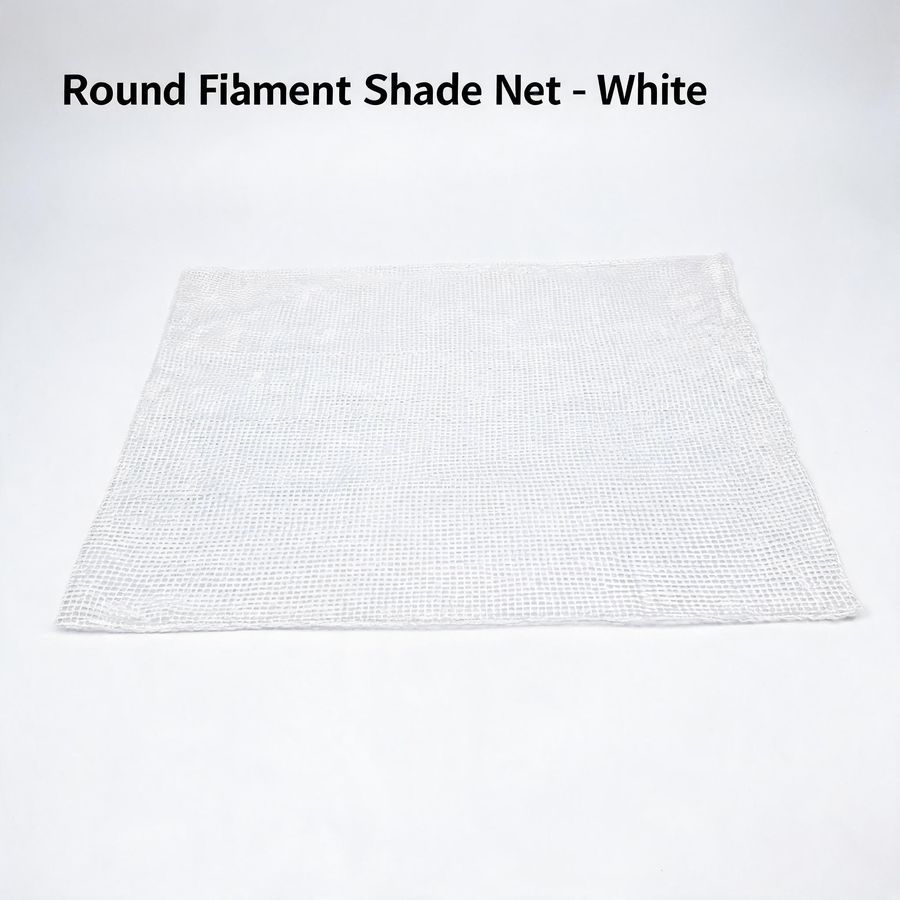 Round filament · white
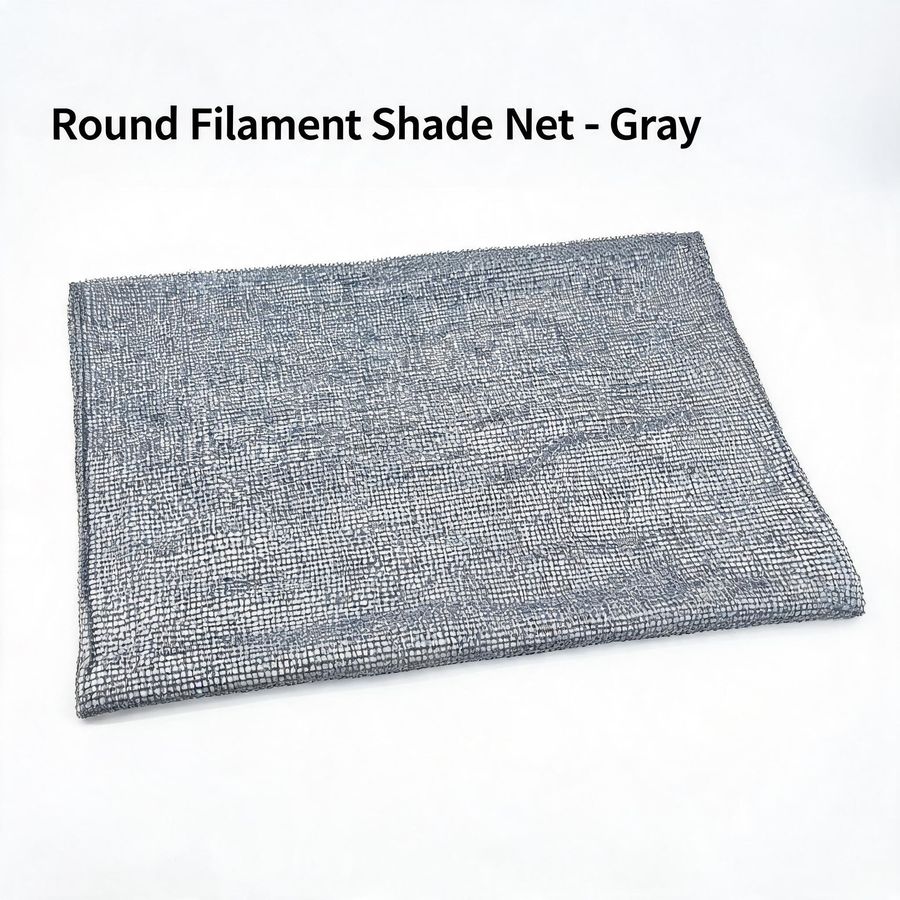 Round filament · grey
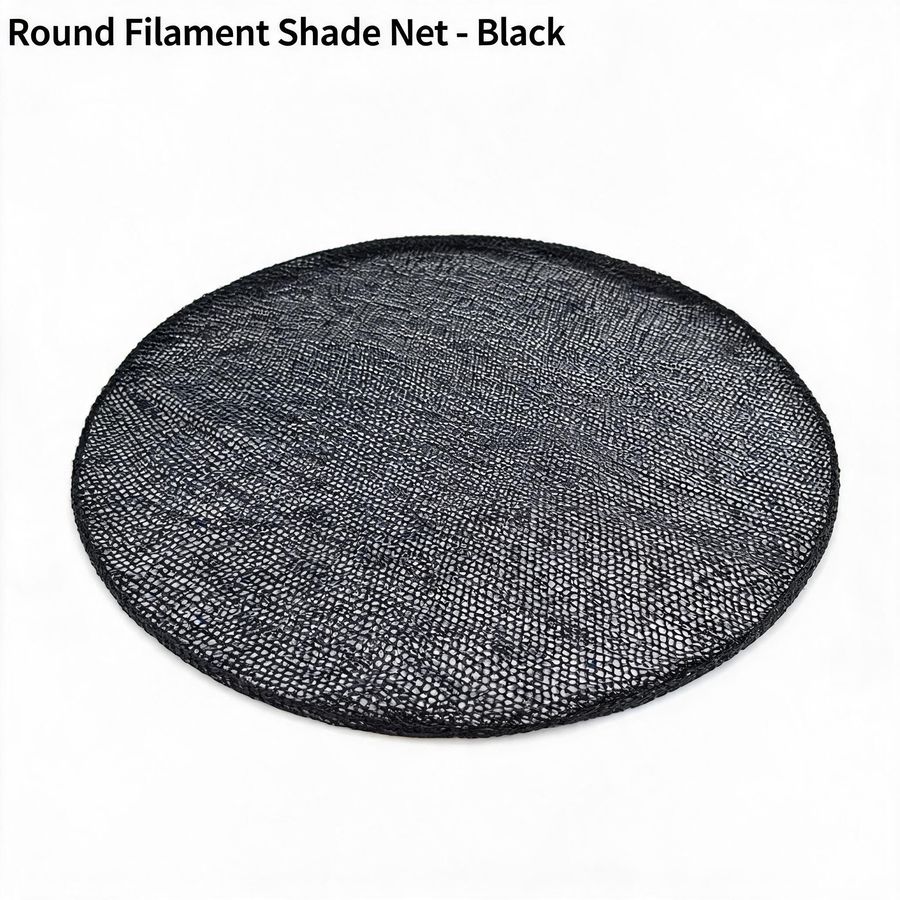 Round filament · black
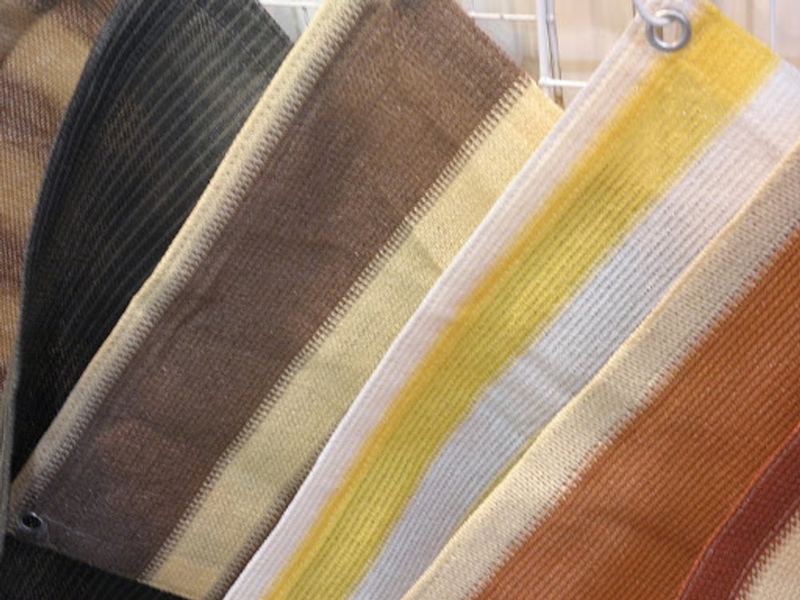 Colour matching
Aluminised construction
An aluminium shade net — also written aluminised shade net or aluminum shade cloth — is a knitted HDPE net with polished aluminium foil strips knitted in alongside the polymer yarn. At the same shade factor as a black cloth, the foil strips reflect most incoming short-wave radiation back out through the mesh instead of absorbing it, so the air under the net runs cooler in direct summer sun.
The second effect is light quality. Radiation that does pass through is scattered by the foil, so under-canopy light arrives as soft diffuse light from the sides as well as from straight above. Growers in the Gulf, East Africa and inland Australia run aluminised cloth on nurseries, young plantations and vegetable tunnels for exactly this reason — lower leaf temperature without the hard, deep shadow a black net casts.
We knit it in silver, white-silver and grey-silver at 150–200 g/m², from 50% to 90% shade, on widths from 1 m to 12.99 m in one piece — enough to cover a retractable screen bay or a whole tunnel roof without a centre seam.
| Specification | Details |
|---|---|
| Material | HDPE monofilament / tape yarn + polished aluminium foil strip |
| Weight | 150 / 180 / 200 g/m² |
| Shade factor | 50% / 60% / 70% / 75% / 80% / 90% |
| Radiation behaviour | Foil strips reflect short-wave radiation instead of absorbing it |
| Colours | Silver, white-silver, grey-silver |
| Width | 1 m – 12.99 m in one piece, seamless |
| Roll length | 50 m / 100 m; screen bays cut to order |
| UV package | HALS + UV stabiliser on the polymer yarn, UV-tested foil strip |
| Edge options | Raw, hemmed, eyelets @50 cm, sewn screen pockets and keder edges |
| MOQ | 500 m² per colour (stock) · 3,000 m² (custom) |
| Reference price | From USD 0.18/m² FOB China |
What to check before ordering. Foil strip density sets both the shade factor and the price — count the strips per metre and ask what shade factor that density measures at. Then ask for aged samples: low-grade foil dulls or delaminates after one season of UV and the reflectance advantage is gone. We send 1 m² swatches cut from the actual production batch before any container is booked.
At the same 70% shade factor the only difference is what happens to the radiation: black cloth absorbs it and re-radiates downward, aluminium foil strips send it back out through the mesh.
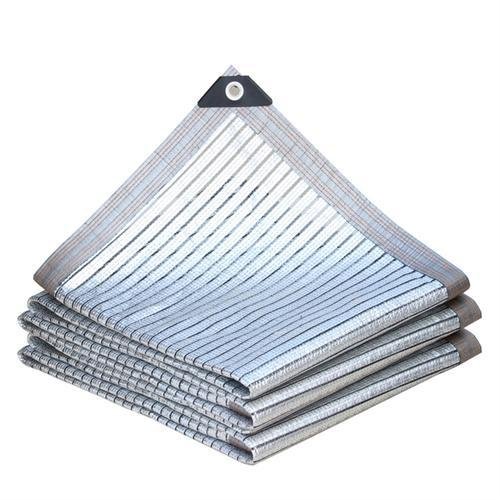 Grommeted corners · folded
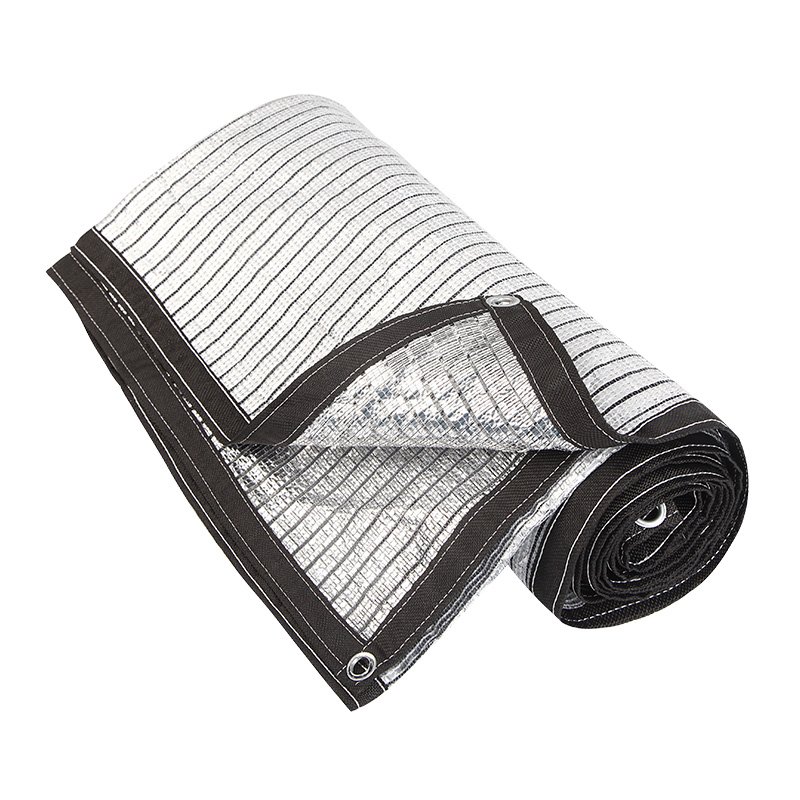 Roll · foil backing
Ask for an aluminium shade net swatch and the measured shade factor →
Width
Most shade netting in the market is woven 4–6 m wide, because that is the width of a standard Raschel machine. Anything wider has to be sewn: two or three panels, a lap seam, a row of stitching and a second fixing line on the frame.
Our widest loom knits a 12.99 m panel in a single pass. For a 10 m or 12 m greenhouse tunnel, a shade house roof or a full orchard row, that means one drop of cloth from eave to eave — no centre seam, no overlap flap, no double wire.
The engineering behind it is the loom-building workshop we started in 1999. We can widen, retune and repair our own machines, so the maximum width is not fixed by what a machinery supplier is willing to sell us.
| Specification | Details |
|---|---|
| Widest loom | 12.99 m in a single piece |
| Standard range | 1 m – 12.99 m, slit to your exact width |
| Seam-free benefit | No centre seam, no overlap flap, one fixing line |
| Wider than 12.99 m | Panels joined with lap seam + double stitching |
| Width tolerance | ±1–2 cm on a 4 m roll; quoted per order above 6 m |
| Typical lead time | 18–25 days for custom width runs |
What to ask for. On any quote above 6 m, ask the mill whether the width is woven or sewn. A sewn panel carries a seam every 5–6 m — the first place shade cloth fails and the first place buyers complain.
See the full 12.99 m super-wide range, with the seam arithmetic →
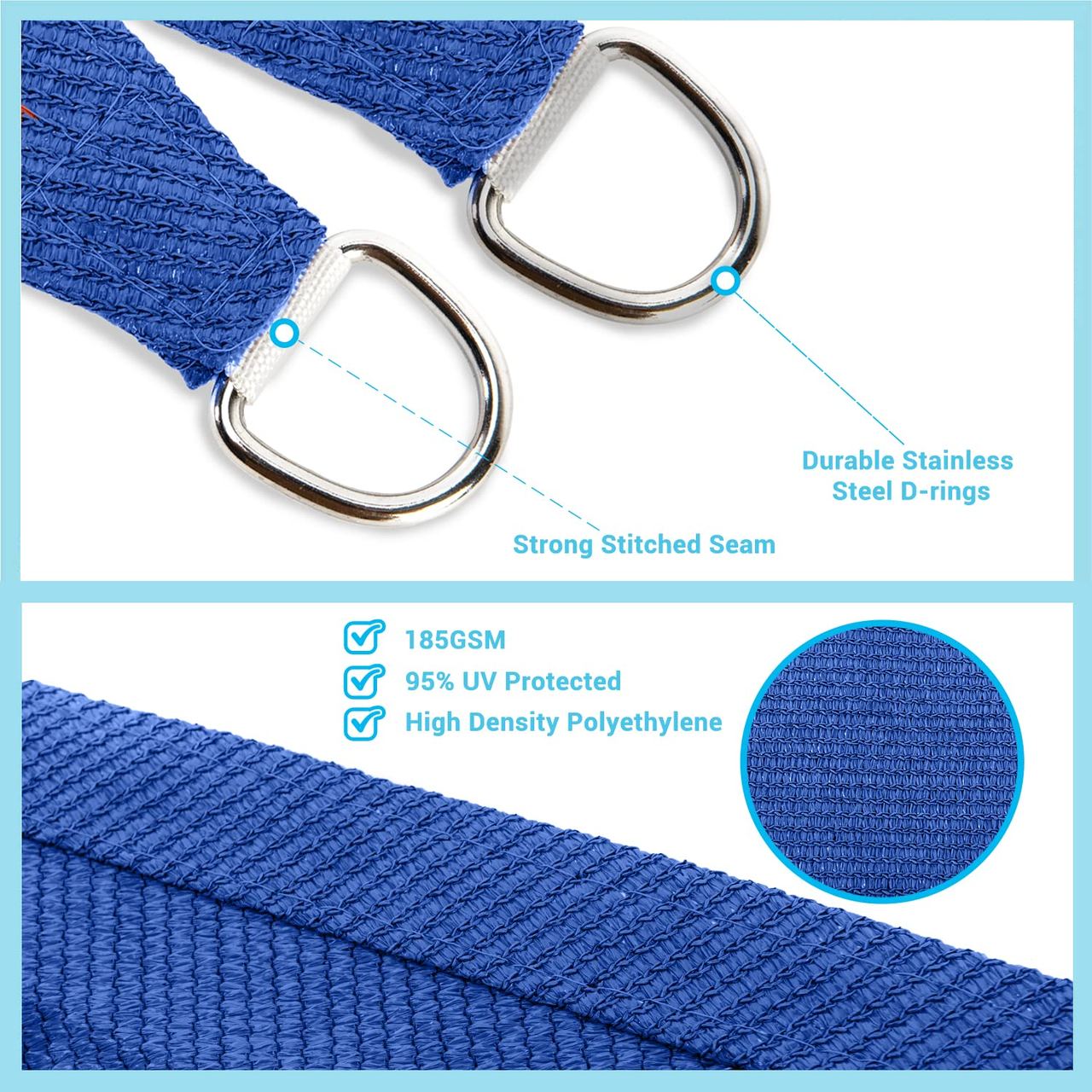
Beyond rolls, we cut and sew finished sails: heavy-duty HDPE in square, rectangle, triangle and right-angle triangle profiles; ultra heavy-duty charcoal for long spans; and fully waterproof sails with welded seams for all-weather cover.
| Specification | Details |
|---|---|
| Heavy duty sail | HDPE, black / grey / sand, from USD 92.50 per unit |
| Ultra heavy duty | Charcoal, 5×5 m square, up to USD 308.75 per unit |
| Waterproof sail | Welded waterproof fabric, grey / sand, from USD 81.25 |
| Right-angle triangle | 2×3×3.6 m, from USD 73.75 |
| Hardware | 316 marine grade turnbuckles, D shackles, pad eyes, snap hooks |
| Mounting kits | Square and triangle kits, packages A–F, USD 48–74 |
Colour matters more than most buyers expect. At the same shade percentage, black cloth absorbs radiation and runs hotter underneath, while white and aluminium reflect it. In the Gulf and in Australian summers we usually recommend white or aluminium for the same 70–80% shade factor.
Three numbers decide whether a container of shade net is a good deal: measured GSM rather than nominal, measured shade factor rather than the label, and actual width. A net sold as 200 g/m² that weighs 175 g/m² is not a 12% saving — it is a shorter service life and a thinner strand that abrades faster.
Ask for the roll weight and the roll area, divide one by the other, and you have the real GSM. Ask for light-transmission readings on the batch you are buying, not a generic certificate. And ask for the width tolerance: 1–2 cm drift across a 4 m roll is normal, 10 cm is not.
We put all three on the quotation, and the same sheet is used at final inspection before the container is sealed.
FAQ
Shade factor is measured by light transmission: a 70% net lets about 30% of incident light through. Because the measurement depends on yarn width, colour and weave, two nets sold as 70% can differ by a few points. We test each batch on a light box and quote the measured figure, not just the nominal one.
About 10 percentage points of transmitted light. A 30% cloth lets roughly 70% of incident light through and suits full-sun vegetables such as tomatoes and peppers, and mixed greenhouses in mild climates. A 40% cloth transmits about 60% and is the usual choice for patios, pergolas, bedding plants, lilies and most vegetables. Weight moves with it: 55–65 g/m² at 30%, 65–80 g/m² at 40%.
Yes, if it is lock-stitch knitted. Woven shade cloth frays and unravels as soon as it is cut, so every panel needs hemming. Our knitted cloth holds its edge, so a 30% or 40% panel can be sized on site with scissors and hung without sewing — hemming is optional, not a requirement.
Yes. Both grades are standard production, from 1 m to 12.99 m wide in one piece and up to 50 m per roll, in black, green, white, grey or a Pantone-matched colour. Stock colours ship in 7–12 days; custom widths and colours take 18–25 days at 3,000 m².
Flat filament tape yarn gives a wider, flatter strand, so it covers more area per gram — cheaper per square metre and very common for agriculture. Round monofilament knits a finer, more uniform mesh that looks tidier and lasts longer under wind abrasion, which is why it is preferred for car parks, patios and privacy screens.
It depends on the climate, not on a material ranking. In high-radiation sites — the Gulf, inland Australia, East Africa — an aluminised net at the same shade factor keeps the air under the cloth noticeably cooler than black, because the foil strips reflect radiation instead of absorbing it, and the light that does come through is diffuse. In mild or cloudy climates the advantage shrinks and black or green costs less per square metre. Appearance counts too: foil cloth is bright silver-white, which some sites want and others would rather hide.
Standard production runs from 1 m to 12.99 m in one piece, with no sewing seam — enough to cover a 12 m tunnel span or a full orchard row in a single drop. Wider covers are made by joining panels with a lap seam and stitching. Tell us the frame width and we will weave to the nearest width so you cut less waste.
With our HALS + UV stabiliser package, 3–5 years is realistic in northern Europe and 5–10 years in high-UV markets such as the Gulf or East Africa, provided the net is tensioned properly and not abraded against sharp frame edges.
Yes. We make heavy-duty and ultra heavy-duty shade sails in square, rectangle, triangle and right-angle triangle profiles in black, grey and sand, plus fully waterproof sails, all with 316 stainless hardware kits. Custom sizes, colours and edging are available.
Wholesale FOB China for 80 g/m² 50% black starts around USD 0.11–0.15/m²; 150 g/m² 75% around USD 0.15–0.23/m²; 200 g/m² 90% green around USD 0.20–0.35/m². The 30% and 40% grades sit at the bottom of that range — lighter cloth, less yarn per square metre. Aluminium-reflective cloth sits higher. Final price depends on width, colour, edge finish and quantity.
Most tunnels use eyelets at 50 cm centres along both edges with tensioned wire or cable, plus a 30 cm overlap between panels. For flat roofs we recommend a 10–15% slack allowance so the fabric can expand in heat without pulling the eyelets.
We print on the poly bag, roll label and carton as standard. Printing directly on the fabric is possible for large runs with a minimum of a few thousand square metres, subject to artwork approval.
Send your size list, shade percentage or drawing — we reply with price, lead time and a freight estimate within one working day.