Ciflower Insect Netting & Fruit Fly Screens
Three screens, three apertures: 45 g/m² for fruit fly, 90 g/m² for whitefly and aphid, 103 g/m² for thrips — with measured light and airflow figures.
Insect & fruit-fly netting
Insect netting is a physical barrier: instead of spraying, you keep the insect outside. The engineering problem is that the aperture small enough to exclude thrips is also small enough to throttle airflow, so the specification has to match the pest, the crop and the climate.
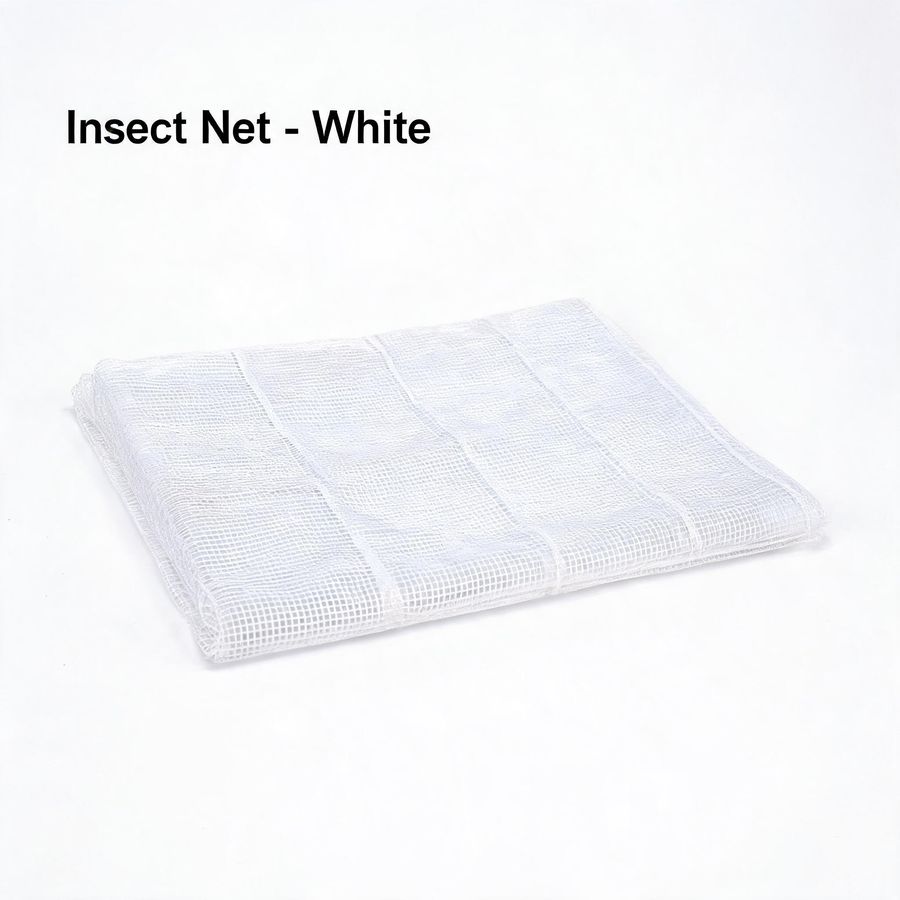
We weave three weights — 45 g/m² for fruit fly, leaf miner and larger insects; 90 g/m² for whitefly and aphid; and 103 g/m² for thrips and other very small pests. All three are HDPE, HALS stabilised, and available in white, transparent and black, with hemmed and eyeleted edges for tunnel or vent mounting.
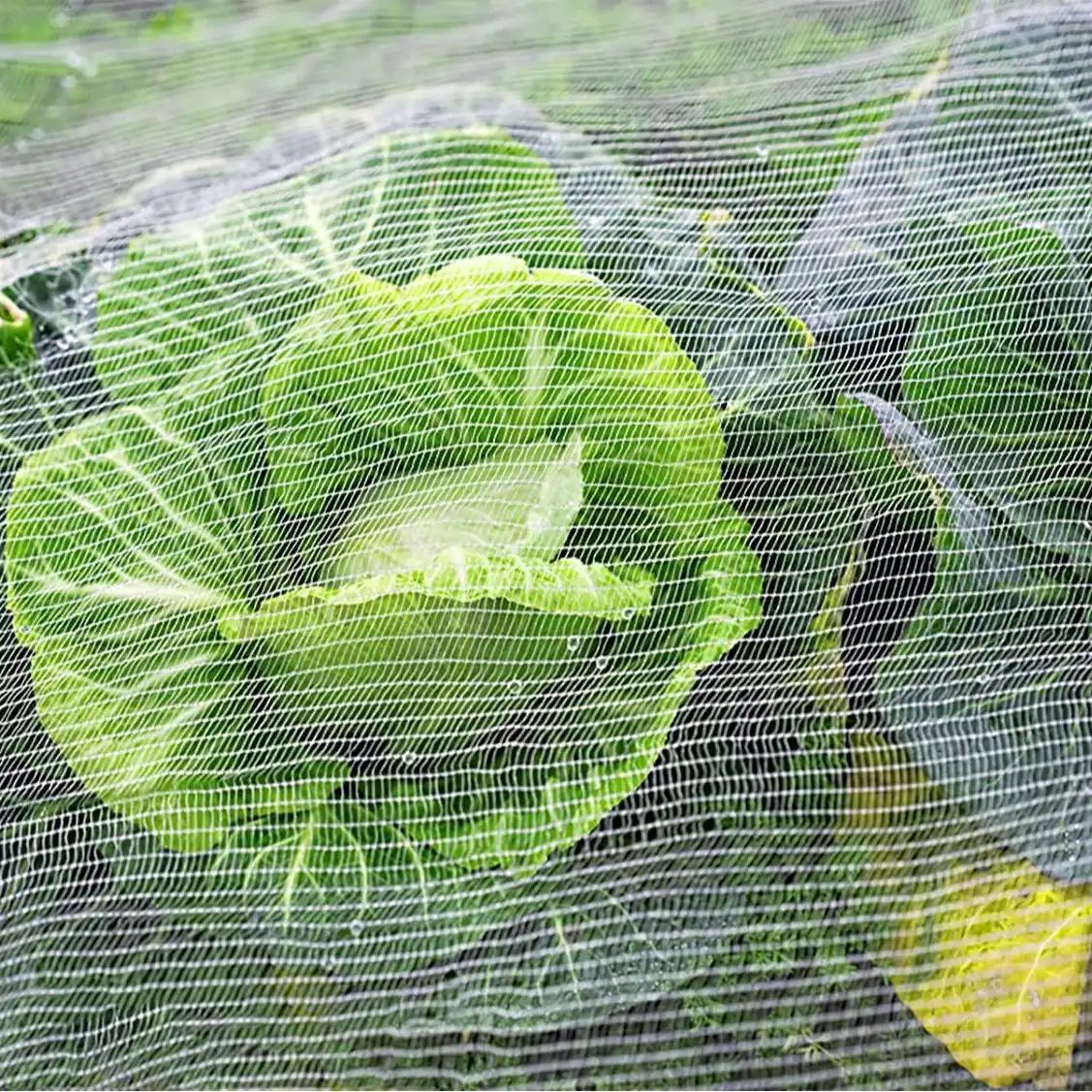
For outdoor vegetable crops the same fabric is used as a floating cover over hoops — it keeps cabbage white, flea beetle and birds off without chemical treatment, and it holds a degree of warmth at night.
| Specification | Details |
|---|---|
| Material | Virgin HDPE monofilament, HALS stabilised |
| Weights | 45 g/m² · 90 g/m² · 103 g/m² |
| Aperture | 1.4 mm · 0.8 mm · 0.35 mm (20×10 to 50×25 mesh) |
| Light transmission | 88% / 80% / 75% |
| Airflow reduction | 25% / 35% / 45–50% vs open vent |
| Width | 2 m – 12.99 m in one piece |
| Roll length | 100 m, or 10 × 7 m panels |
| Colours | White, transparent, black |
| Edge | Hem + eyelets @50 cm, rope border, or raw |
| Accessories | Zip doors, Velcro strips, fixing clips, tension wire |
| MOQ | 500 m² stock · 3,000 m² custom |
| Reference price | From USD 33 per roll (45 g/m²) |
Matching mesh to pest
| Pest | Body width | Mesh needed | Our weight | Trade-off |
|---|---|---|---|---|
| Fruit fly (Ceratitis, Bactrocera) | 1.2–1.5 mm | 1.4 mm / 20×10 | 45 g/m² | Best airflow, excludes fly only |
| Whitefly (Bemisia, Trialeurodes) | 0.9–1.1 mm | 0.8 mm / 32×32 | 90 g/m² | Balanced for most greenhouses |
| Aphid | 0.6–0.9 mm | 0.6 mm / 40×25 | 90–103 g/m² | Needs well-sealed structure |
| Thrips | 0.3–0.4 mm | 0.35 mm / 50×25 | 103 g/m² | Highest airflow penalty; plan extra vents |
| Leaf miner | 1.5–2.0 mm | 1.4 mm / 20×10 | 45 g/m² | Usually combined with yellow traps |
A 103 g/m² thrips screen is not 'better' than a 45 g/m² fruit-fly screen — it is a different tool. Buying the finest mesh for a whitefly problem costs airflow, raises humidity and can increase fungal pressure.
Applications
Cabbage & brassicas
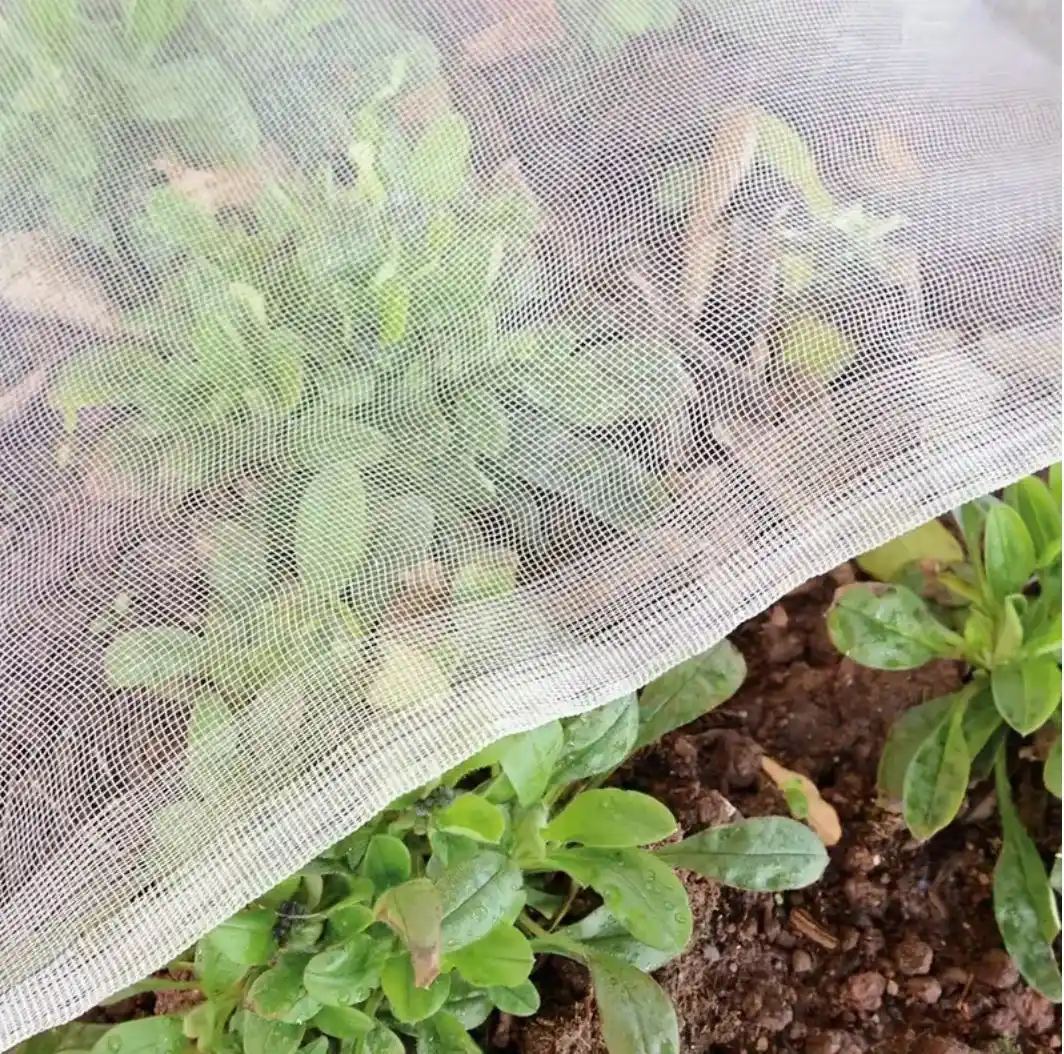
Vegetable beds
Greenhouse ventsScreens are fixed over roof vents and side openings with aluminium profiles or cable. Sealing the structure matters as much as the mesh: a 1 cm gap around a door defeats a 40-mesh screen.
Where cross-pollination or seed purity matters, insect net also excludes pollinators — the same barrier works in reverse when you introduce bumblebees inside.
Fruit-fly screens are draped as side nets around ripening blocks, usually combined with bait stations. The net also reduces bird damage and sunburn on exposed fruit.
Physical exclusion is the backbone of organic pest control and of export programmes with strict maximum residue limits, where one rejected container outweighs the whole netting budget.
FAQ
Thrips need 0.35 mm or finer (about 50 × 25 mesh); whitefly 0.8 mm; fruit fly 1.0–1.4 mm. Finer mesh blocks more pests but also cuts airflow, so choose the coarsest mesh that excludes the pest you actually have — not the finest available.
Yes, and the reduction is significant: a 40-mesh screen can cut airflow by 40–50% compared with an open vent. Greenhouse designs compensate with larger vent area, forced ventilation or a 50-mesh roof and coarser side screens.
Our 45 g/m² screen transmits about 88% of light, 90 g/m² about 80%, and 103 g/m² about 75%. White screens diffuse light and raise the proportion of scattered light, which many crops prefer.
Yes — for low crops such as cabbage, onion seed and herbs, the net is laid over hoops or floated on a low tunnel and weighted at the edges. It must not touch the crop, or pests will feed through the mesh.
All our insect screens are HALS stabilised. In high-UV climates expect 3–5 seasons; in northern Europe 5–7 seasons. Screens that are taken down and stored dry in winter last longer.
Yes. Edges can be hemmed with eyelets at 50 cm, fitted with a rope border for tunnel fixing, or left raw for overlaying hoops. Zip and Velcro door kits are available for greenhouse entrances.
2 m to 12.99 m in one piece, so a 10 m or 12 m tunnel is covered by a single drop with no centre seam — no overlapping joint for whitefly or thrips to find, and one fixing line instead of two.
Reference FOB China: 45 g/m² from about USD 33 per roll, 90 g/m² from USD 76, 103 g/m² from USD 67 per 10 × 7 m roll. Price per square metre falls noticeably above 5,000 m².
Send your size list, shade percentage or drawing — we reply with price, lead time and a freight estimate within one working day.